Interview by Steve Chong (ARPS)
Photos by Ursula Abresch (Canada)
What does photography mean to you?
It is my way of giving glory to God in this beautiful world.
 How do you describe your work?
My style can loosely be classified as photo-impressionism.
Photo-impressionism is a tool that allows me to get to the essence of what makes a subject what it is. For example, a tree, let’s say a ponderosa pine: what is it that makes a ponderosa a ponderosa, what makes it “speak” so to say, what is the spirit of that tree so that you could show as little as possible of it and yet know, with certainty, that it is a ponderosa?
That is an aspect of photo-impressionism that I like. You can abstract subjects and provide much more character than with a representational photo. Photo-impressionism allows me to express feelings without having to say a word. It allows me to put down thoughts, dreams, and fleeting moments in time, when a small change in light can make the difference between utterly glorious and plain drab.
Perhaps more than anything though, the concept of photo-impressionism made me pay attention to colours. I love colour! I play with colour and use it almost as if it were the subject itself, which, I guess, in a way, it is, at least in photography. Light is colour.
Do you think that your studies in Education with a concentration in Art and History had help you to become a great photographer as you are now?
No, and yes. All studies are good in general. Some of the people I met while attending university were (and are) quite influential in my thinking. But specifically, no, the degree in Education doesn’t have much to do with being a photographer.
I find the bokeh in many of your images are just so sweet, can you share with our readers how did you achieve that kind of effect?
A good bokeh depends on various things. One is the lens you’re using. I pretty much always use the Sigma 150mm f/2.8 macro, which has beautiful bokeh rendition. The other is the distance between lens/subject/out of focus background. The closer the subject is to the lens, the greater the out of focus effect of the background (and foreground), but the distance between the in focus subject and any out of focus areas that are distinct makes a huge difference also. When I make a picture, once I have a decent subject, I pay more attention to the background/foreground than to the subject itself. I pay particular attention to colour. Out of focus colour areas are an integral part of how I compose my pictures. Playing around with distances (lens to subject to background/foreground) is what makes the difference after you have the subject and the colour/background you want.
 Your art is both subtle and abstract, what had inspired you to develop your current style?
It is in part some of the artists that I admire. When I first started getting serious about photography, I started reading the books by Freeman Patterson (a Canadian photographer). I liked his style, and I tried to adapt his thinking to my thinking. These days I often draw inspiration from painters, not so much in the sense of trying to find similar subjects or styles, but in the sense of trying to see the world the way they saw it. It makes my view of the world more varied. Painters from Canada, in particular Western Canada, influence my work. We live in the same world, so I like to see if I can see what they saw the way they saw it. The works of Emily Carr, especially her fantastic studies and paintings of trees, are a constant source of inspiration for my photos. For a while, and even now, I was quite inspired by the works of Takao Tanabe, a more recent painter than Emily Carr, especially his waterscapes.
Another factor is where I live. I live in British Columbia, Canada. British Columbia is a beautiful province. I live in the interior, in the West Kootenays. It’s a mountainous area, with lots of trees, lakes and rivers, waterfalls, rocks, and wildlife. British Columbia has become an important subject matter in my photography. It is a subject for some of the more representational images, and also for many of my more abstract images, where I try to reflect the essence of a subject, or where I use a subject to express emotion. For example, many of my close-up images of the Columbia river are an attempt to reflect my own thoughts and feelings in pictures.
To sum up, I think my style is simply an expression of how I think, and how I see the world.
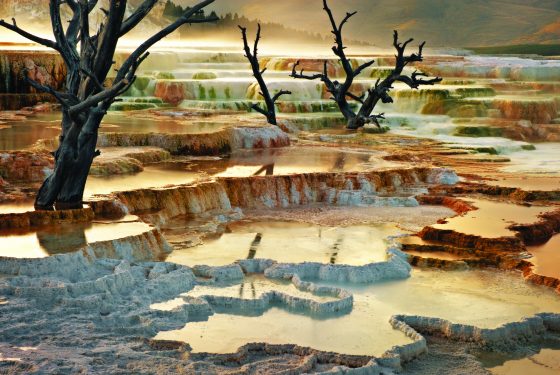
Can you describe to our readers the making of the shot “Out Of This World”?
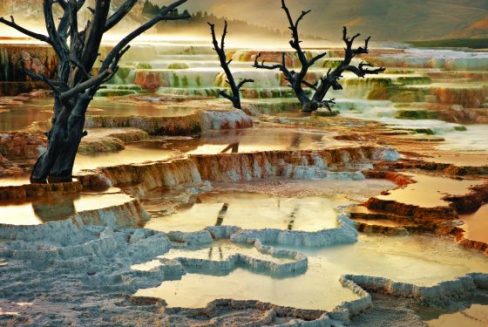
“Out Of This World” is a photo I made in May of 2009, at Mammoth Hot Springs in Yellowstone National Park, Wyoming, USA. It was made in the evening, on a rather cool and cloudy day, camera on tripod. This place actually looks like this at certain times of the day.
In post-processing, I tried to bring out some of the shadow areas that were a bit dark, and I tried to intensify the overall gold feeling of the moment.
The picture looks strange in the sense that it is difficult to believe that this place actually looks this strange in real life, at certain times of the day in particular. I think that’s what I was trying to bring out here more than anything else is the strangeness of this place.
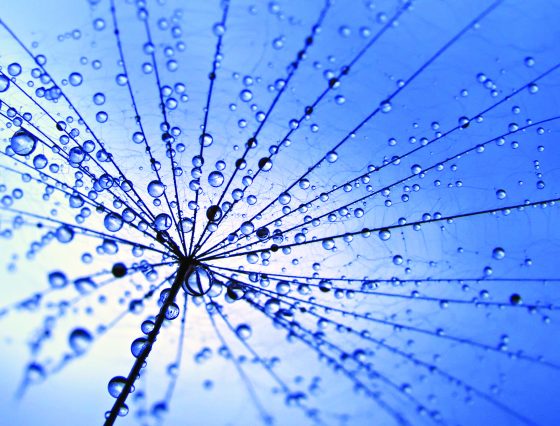
The shot ‘Umbrella”, really takes a photographic eye to see it, how did you discover the subject?
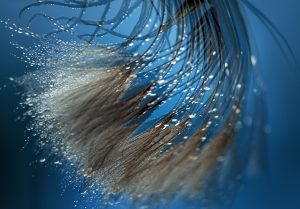
I like looking at things close up. Have you noticed how certain leaves and seeds, when they have water droplets on them, tend to have one bigger droplet in the middle? The leaves of lupines do that. So do these individual seedlings. I think, the “umbrella spokes” of the seedlings work almost as funnels, so that when there is dew on the seedlings, or when you spray water on them, a bigger drop forms at that confluence of the spokes. This bigger drop serves as a magnifying glass that shows the beautiful pattern of the spokes. How do I, or anyone, discover these subjects? Just by looking at the world around us, close up, from further away, taking time to see what’s really there.
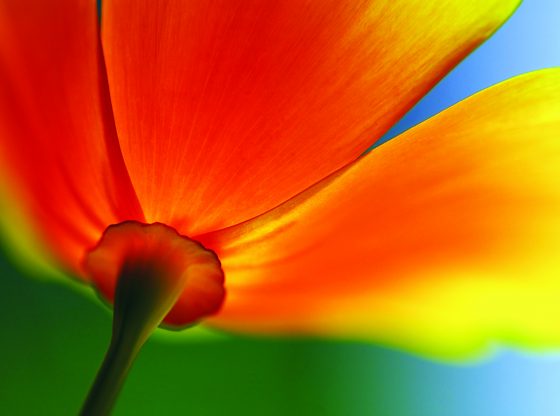
Lets talk about the image “summer”, how did you conceptualize the image?
“Summer” was created for a challenge at www.DPChallenge.com. The challenge was “flowers”. “Summer” is a picture of a California poppy. California poppies have beautiful memories for me, as they grew over the hills by the ocean in Valparaiso, Chile, where I grew up. My father sometimes would take me there and let me pick a big bunch of them to take back to my mother. I remember how cool and fresh the leaves felt, still do, how green they were, how delicate the flowers looked, the orange on green, how fantastically beautiful the hillside and my little bunch of flowers for my mother looked. I love these flowers. I think, when I made this picture, I tried to put these feelings into it, but concentrating on the one thing that makes these flowers different and special … that little round thing at the back of the petals. It defines them, as the sharpest point. But the colour is what brings it together, the warm yellow/orange on cool darker greens, with a bit of blue for the sky.
What propelled you to create the water series?
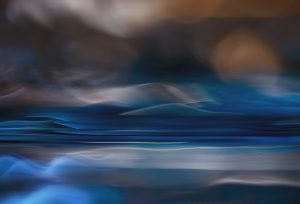
Whenever I feel anxious or need to think, I go to water. I like water. It expresses feelings very well, for me. I guess I use water as an analogy for emotions. Water is smooth, mysterious, deceptive, inviting … it is like a good story just waiting to be told.
You have obviously created some wonderful images, which are the ones your favourite and why?
My personal favourites tend to be the Fall images. I love Autumn, the golds and reds and browns mixed in with the deep blues and greens and even purples! I love the smell and the sound of Autumn, the crunchiness of the leaves when I walk in the woods, the earthy smell, the coolness of the air. “An Autumn Song” puts these things into a photo, and it is one of my personal favourites.
You have been using Lens Baby in some of your work, what is your thought about the lens?
I think LensBaby is a great tool, fun to try, interesting to experiment with, but also quite often misinterpreted. Pictures do not become “art” just because they contain blur or distortions, and I think that is the most common misinterpretation of LensBaby. But, that said, it is a wonderful tool!
My photo “needles” was made with the old LensBaby II, as was “in my garden”.
Some said that shooting still life is very challenging, what is your opinion about that statement?
I think they’re right. It is challenging. To me the main challenge in still life is to make something interesting out of a still life. It just is very difficult to engage the viewer in a semi-closeup picture of objects.
What kind of knowledge do you think, especially for a beginner could gain from shooting still life?
I think still life would allow beginners to learn both about composition and about control of light.
What are the elements you are looking for in a subject when creating still life?
I’m going to talk about abstract close-ups instead of still life, because I really do not much enjoy working on still life, but I do very much enjoy working on abstract close-ups. More than anything else, when I work on abstract close-ups I am looking for 2 aspects:
– The “technical” aspect – good play of colour. If the colours aren’t there, in general, for me it doesn’t work. After that, interesting shapes to support the colour statements. Finally, good light to show off those shapes and colours.
– The “emotional” aspect – can I somehow create a story or a scene out of the setting but without ever really having a scene or story shown? Can I express particular feelings with the picture?
It is the emotional aspect that, in the end, makes the picture. You can have all the fantastic colour, shapes, light in the world, but if you don’t connect to the viewer at an emotional level, the picture is simply going to be a good exercise, a study, but not a finished piece.
This actually goes for all photos, not just abstract close-ups.
Connecting to the viewer is so important!
Tell us more about your equipment, including your computer software and hardware.
Camera bodies: Nikon D200 and Nikon D7000
Lenses: Nikon AF Nikkor 50mm f/1.8
Nikon MF Nikkor 200mm f/4 AIS
Nikon MF Zoom-Nikkor 75-150mm f/3.5 E
Lensbaby 2.0 and Composer
Sigma 150mm f/2.8 EX APO Macro EX DG HSM (default lens)
Sigma 70-300mm f/4-5.6 APO DG Macro
Tokina AF 12-24mm f/4.0 AT-X Pro DX
Others: Manfrotto 055PROB tripod with Manfrotto 486RC2 ball head
Processing: PS-CS5 and assorted plug-ins on a MacBook Pro connected to a Cinema Screen
HP B9180 Photosmart Pro printer
In your view what constitutes a good photo?
More than anything else, one that connects to the viewer (and that includes the photographer).
How do photos connect with viewers?
One is story – a good story is always interesting.
Another is mood – similar to story, but more abstract, a feeling, something that people can connect with when looking at the image.
Great light – To tell the story, or showcase the mood, or bring out the beauty of the subject.
Another is plain visual beauty – it can sometimes overwhelm the viewer to just see plain beauty, and that becomes the emotional content of the image.
What would you do if you are not a photographer?
I don’t know 🙂
What are you currently working on now?
Since it is now Summer and the wildflowers are out, I am working on making more wildflower pictures. I also am working on trying to get more expression into my pictures, to get the moods stronger, but at the same time remain very abstract or even turn more abstract than before. Two examples: I am working on a series on colour; pictures that show the essence of the particular colour. And, I am working on a series of pictures that depict weather; not just photos of rain or snow, but photos that make you feel the rain on your face or the snow under your boots.

She has a degree in Education with a concentration in Art and History. She now dedicates most of her time to photography.
This article was published in Advanced Images Issue 57.