Artistic Licence
Interview by Steve Chong (ARPS)
Photos by Stephen Frink (USA)
1. What does photography mean to you?
Photography was a passion that came later in life. As a child I rarely took pictures, and even through college it meant nothing to me. But, in graduate school I took a photo class just for fun, and the magic of the black and white image coming up in a try of Dektol was fantastic and alchemy I’ve never forgotten. Now, it is a means of communication. I try to conceive concepts and find a single image or short portfolio to tell the image. It is a ‘frozen moment in time” as some have said, and the “decisive moment” as others speculate. But, for me it is the ultimate pantomime, a story told without words and open to interpretation, but communication all the same.
2. What has been the driving force for you to choose underwater photography and make it a career?
I was a competitive swimmer when I was younger, all the way through college in fact. Being in the water came naturally for me, but I grew up in landlocked Illinois. It wasn’t until I went to graduate school in California that underwater photography was even a possibility. However, my interest in photography came before my interest in scuba diving. And, even then I only got certified because I wanted a part-time job cleaning boat hulls while in school. I don’t know if there was a single driving force that made me an underwater photographer. More like the “death of a thousand cuts’ cliché”. My thousand cuts were the culmination of little things that pushed me towards marine photography. Competitive swimming, photo classes in graduate school in California, a good deal on my first Nikonos, and finally a fortuitous visit to Key Largo, Florida where I met some guys who owned a dive shop willing to let me rent a little space to open a photo store. That was 1978 and I began renting UW cameras and processing E-6 film. The rest came to me one step at a time, one opportunity gratefully leading to the next.
3. How much did underwater photography affect you as a human being and a photographer?
I think most significantly I’ve seen how profoundly the ocean has deteriorated in the short time I’ve been working in underwater photography. It is frightening the effects that ocean acidification and overfishing and shark finning are doing to the ocean, so quickly. It makes me want to do little things to help, like not eating reef fish, for example. But, it also drives a desire to do bigger, better things for the ocean. As a publisher (for Alert Diver magazine) I can give voice to marine conservation issues and as a photographer I can hope to show the beauty of the underwater world so those who know little of the sea can gain intuitive appreciation and likewise share a desire to conserve and protect.
4. How different is underwater photography compared to another genre, such as portraiture photography?
Underwater photography is massively different from any other photographic discipline, if only because water is 800 times denser than air, and has a cyan colorcast. The physics makes the tools and the execution different. Of course, with portraiture you can, and should, talk to your subjects. With underwater models I can direct them with hand signals, and with marine life I can coax them; but limitations of time, water clarity, depth, light transmission, and subject availability will combine to make underwater different from all other photographic specialties.
5. What do you hope to achieve through your photography?
Photography became a vocation early on, so I never really experienced it for very long as a pure hobby. But, it has never too often felt like work. Many parts of my business are work, things like writing articles or office work. But the joy of finding the subject and capturing it in a better or different way remains as compelling now as it was when I began my professional career in 1978. Having said all that, I hope it continues to pay the mortgage and puts my daughter through college. If it pays the bills and feeds my creative passion, it was a good fork in the road that led me to photography.
6. What unique photographic challenges have you had to overcome?
Unlike most divers who find scuba to be a safe and exhilarating sport, I have had the bends a few times. My issues always evolved from going too deep or staying too long to pursue some photo opportunity. If I had it to do all over again I would have paid better attention to the rules about safe scuba diving when I was first going through my certification, and I would have been a little less greedy about staying on the bottom too long just because I was having fun taking pictures. Another 10-minutes off-gassing on the way up from some of those dives could have saved me months of time spent healing.
7. Can you tell us something about your equipment?
I am a Canon Explorer of Light, the only marine specialist in this group, so it should be no surprise I shoot exclusively with high end Canon digital SLR cameras and lenses. I use SEACAM housings and strobes, see more at http://www.seacam.com.
8. Do you shoot with available light, or do you take strobes underwater with you?
I use strobes for most of my underwater photographs, for images are very monochromatic blue in the absence of artificial light. But, with artful application of strobe, there may be no environment on earth as vibrant as the world beneath the sea.

9. Obviously Mother Nature is facing some irrecoverable damage inflicted by human being, what do you think as a marine photographer could do to help improve the situation?
We really are at critical mass here, a tipping point with the world’s oceans. The oxygen generating capacity of the ocean is in jeopardy from ocean acidification, the efficiencies and unrelenting voracity of the global fishing fleet is taking out far more than it can ever regenerate. The fish stocks are being depleted to the point that there aren’t enough fish, in proximity, to mate. Corals suffer this same hazard of extinction. Some things humans do is stupid beyond comprehension, like finning sharks for shark fin soup. Other things people simply wouldn’t know without researching. For example, if any caring citizen of the planet knew how destructive and wasteful the shrimp fishery is, they would never ever eat another shrimp. But, there are sustainable fisheries, and people need to invest a little time and conscience into making the right choices. People can eat fish and drive cars and flush their toilets. They can even have children. But unless we, as a global community, begin to educate ourselves about environmentally sustainable actions we can fit into our lifestyles, I fear the ocean is doomed.
10. In the shark series, how did you feel when you are facing one of the most fearsome creatures so close?
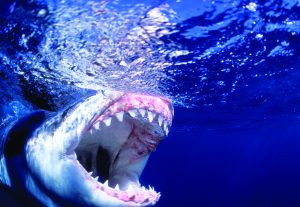
I find sharks more exciting than threatening. But, as in any underwater photography, to do it well you must be close. So, you do have to manage risks and sometimes hope for the best. For the most part, sharks aren’t interested in eating people, but still an accident could have disastrous consequence with even a casual errant bite. Definitely, one needs to be careful around sharks.
11. You have obviously travelled to many parts of the world, where was the place that left the most profound memory and why?
People often ask where is your favourite part of the world to dive, and I always ask do you mean if I was travelling there by dive boat or by time machine? Some of my favourite places are now too popular to offer the wilderness experience I once enjoyed there. I first dived the Red Sea in the very early 1980s. It was still Israeli at the time, and I think that may have been the best diving I’ve since seen on the planet. Now I think the best diving is likely found throughout certain areas of Indonesia. It is vast and biodiverse. Unfortunately, even here the sharks have been overfished, but for healthy coral reef and small to medium sized fish, spiced with regular pelagic encounters, Indonesia is tough to beat these days.
12. What was it like to work with the dolphins?
Dolphins are a magical experience. There are a few places where one can consistently interact with wild dolphins, and those are very special indeed. Of all my dolphin experiences the one most spiritual was the time I was doing a long breath-hold with a pod of dolphins and I stayed a little too deep and too long to get back to the surface. I was fearful of shallow water blackout as I began my ascent, which of course would have been fatal as I was alone in the water at the time. About that time my mind registered fear, the dolphins quit their forward motion and the whole pod formed a tight circle around me until I got back to the surface. As soon as I took my first breath they broke formation and went on their way. But I know with certainty for that brief moment in time they knew I was in trouble and were there to help me if they could.
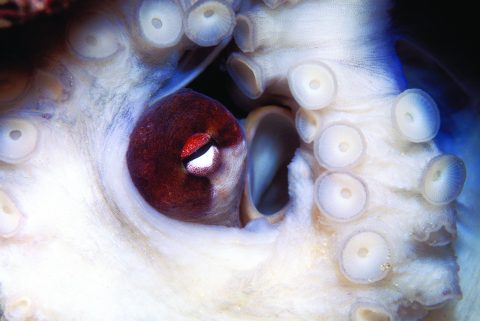
13. I am sure our readers would be very interested to know, in the series Reef Minutia, image no #25, how did you get so close??!!
This one was not at all difficult because the octopus was in a reef crevice and had nowhere to go without actually coming closer to me. But, I am always conscious of an animal’s “field of flight”. How close can I come without alarming them and what can I do to make my approach more benign so as not to spook them.
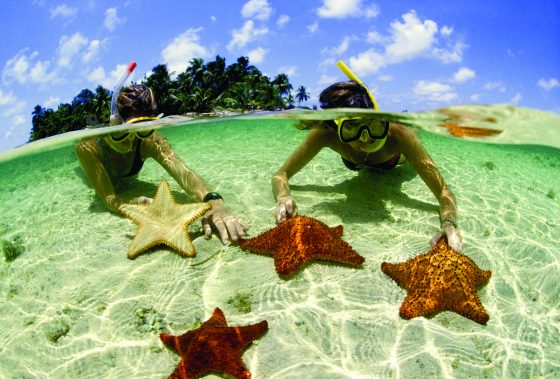
14. Image no #18 in Tropic Splendor is just fabulous, can you tell us something about that image?
This is what we call the “over/under” technique, half above and half beneath the surface. Finding appropriate subjects is really the hardest part of a shot like this. The island in the background and starfish in the foreground gave interesting elements for the entire composition, shot in Belize.
15. As a marine photographer, in your view, what do you think constitutes a great underwater photograph?
I am often asked to judge underwater photo competitions, and I finds myself always considering “degree of difficulty” as if it were a springboard diving competition or something. Even the world’s best shot of a Christmas tree worm does not excite me too much. But, rare megafauna or extraordinary reefscapes do enthral. To me a great underwater photograph is a mix, in almost equal parts, of the underwater spectacle and the technical achievement to capture. Luck favours the prepared, experienced, and those invested in dive travel to productive or unusual destinations.
16. Any tips in taking great underwater photographs?
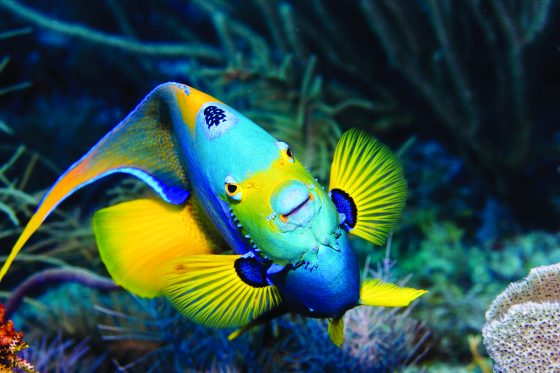
It is cliché to say, but get close. The best photographs happen with proximity and mature lighting skills.
17. What is your advice to photographers, who wish to venture into underwater photography?
Be safe, as no photograph is worth getting hurt physically or damaging the reef or overly stressing the marine life. It took me a long time to learn that simple premise.
18. What are you currently working on now and what are your plans in the future?
I am enjoying my role as publisher of Alert Diver Magazine, for the Divers Alert Network. I find I enjoy the physical process of building a magazine, and getting the best possible photographic reproduction on the printed page. It allows me to provide support and mentoring to other talented photographers as well. I hope to stay involved in publishing for a long time, as it seems a natural evolution to my many years as a writer and contributing photographer for other magazines.
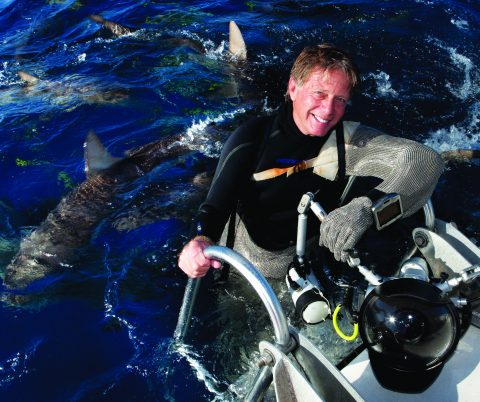
Not only that, he is also the publisher of a beautiful quarterly magazine for the Divers Alert Network, ALERT DIVER. He has also been the Director of Photography for SCUBA DIVING and a contributing photographer for SKIN DIVER magazine for 17 years. Frink has also authored a coffee table book entitled Wonders of the Reef and teaches Masters level courses of Stephen Frink School of Underwater Digital Imaging in his home waters of Key Largo, Florida.
www.stephenfrinkphoto.com
This article was published in Advanced Images Issue 59.