Photography is to me more
than painting with light. Just
like an oil painting, it takes
more than simple brush
strokes to turn canvas and
paint into art.

How did you discover photography?
I discovered photography the same time when I discovered digital art and for me, the combination of the two occurred as an amazing new way to express myself. It wasn’t just a way to channel my creative energy, but also a trigger to my creativity than had taken a different path, away from the visual. When I discovered photography, I already had a background in visual arts (painting), but I decided I wanted to become a journalist. One semester in 2003 I had a little too much time on my hands and I started studying Photoshop, and soon after, ‐ photography. The resources were scarce, therefore I started frequenting the British Council Library, which had a very nice collection of photography book, from theory to history and to the newest practices.

What does photography mean to you?
Photography is to me more than painting with light. Just like an oil painting, it takes more than simple brush strokes to turn canvas and paint into art. There is a great deal of factors that, to me, make the difference from snapshot to art: thought, concept, vision, exploration, emotion, perspective, technique, and so much more. I don’t take photographs, I make them. It’s a way of expression, and it takes more than a press of a button to distill my vision into a final image.
You seem to have an inexhaustible flow of inspirations and ideas, how do you achieve that?
There’s no recipe, it just happens… I guess I am one of the fortunate who never run out of inspiration. I have more ideas than I have time to implement. That’s why I keep a sketchbook – so I don’t let them go to waste… It has happened for me to sketch an idea and only proceed to shooting a year after (A Fairy Tale).
I can say honestly that everything around me inspires me. The good and the bad, the ordinary and the extraordinary. All my experiences and my perceptions over the world around me and the world inside me are triggers for the images I envision. Art inspires me and influences me, consciously and unconsciously. I rarely need to search for an idea, they mostly come to me willingly.
What inspired you to develop your current style?
My current style developed as a natural process of evolution. I couldn’t say what determined it, but I have always had an inclination towards surrealism and a desire to put meaning (concept) in my work. In the beginning, my images were dark, very emotional, and technically less complex. It was a process of learning, on one hand, and of cleansing, on the other hand. I was exorcizing my demons. Afterward, my images brightened up and spoke with more hope, while technically they became more complex. More recent works are rather speaking of the world than of myself, they have stronger concepts and are dense in symbolism.
Your images are always enigmatic, mysterious and thought provoking, how much would that reflect your personality?
As I mentioned before, I need to always put a meaning in my work. I like to make people think, to make them wonder, to make them want to seek beyond the surface and search for lies beneath a “pretty picture”. I also like to make them feel, to make them relate and to make them explore their emotions. I believe this is the purpose of art. I do not believe that I have an enigmatic, mysterious personality, although I admit that I do have my oddities.

I realized that you have just published a book, can you tell us something about the book?
Temporary Peace is my first book, where I gathered my best photography from the past three‐four years, a total of 33 pieces. It’s a large format, hard cover book, with a total of 80 pages. I wanted this book to be special, a collectible art piece that’s perfect in every detail. Every photograph is accompanied by a title page with beautiful graphics inspired by the elements in the artwork and with captions explaining something about the meaning of the image presented. It will be launched at the end of August and will be available to purchase online from my website.
I understand that it takes a long time for you to create an art piece, can you tell us which of your images took the longest time and why?
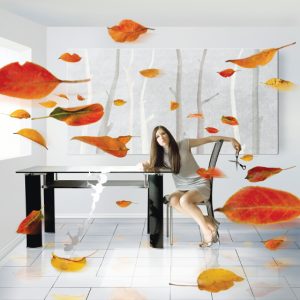
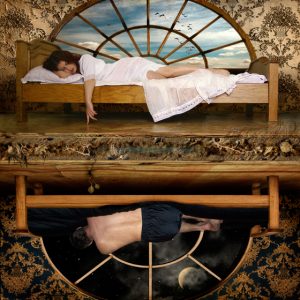
Some of my pieces took several week of mostly intensive work to put together. Images like 15.000 Miles, In My Other Life, A Quest for Beauty are some of the most complex in details that I’ve created. Others come close (Sunset over the Ocean, the Gravity of Fear, The Mysterious Disappearance of Miss Peregrinne Ploot). Lately, it’s been taking me even more time to create my images, and it’s not so much about the complexity of the details as it is because of the planning part, the research, and the obsession to refine every detail to perfection. My most recent work, Exodus of the Leaves, took me more than two months to complete.
Do you have any assistants to do the setup? Or do you prefer to work alone?
I like to be in control of everything I am doing for my photography, but my husband Eric is always assisting me with the setup. With some of my photographs where I was the model, he’s been the one pressing the button for me (like in Sunset over the Ocean, The Fate of Eve, of The Mysterious Disappearance of Miss Peregrinne Ploot).
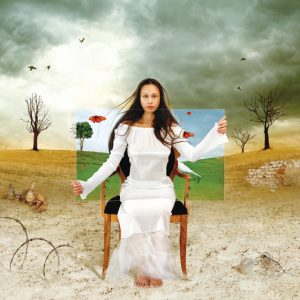
Obviously a lot of work had gone into the image ʺA Quest for Beautyʺ, can you share with our readers, the ʺmaking ofʺ the image?
Definitely one of my most complex works, A Quest of Beauty started as a challenge – to illustrate Beauty for a chronicle at Neosynthesis, an art group that I used to be a part of. Beauty can be understood at many levels: from the most personal and intimate, to theoretical ideal, and to metaphors evaluating the world and humankind to what they have become. I tried to comprise different levels of understanding into this picture. There are many angles and lights in which this image can be looked at and into. But from idea to refined image there is a long way. A lot of planning went into this image, and it started with a pencil sketch on paper. I always sketch before I start shooting, this way I can plan the session better, and I know exactly what I want to achieve. In the studio shot, I had the model sitting on a chair and holding a large piece of glass. The rest of the elements is the image come from my personal archive. Between these, it was just a matter of putting the pieces together and creating the right atmosphere. A lot of selecting, cutting, blending, color adjustments, and a little bit of painting (to create the flowing hair look). I always use a graphic tablet and pen in my Photoshop work.

Your image titled ʺSuicideʺ had won you many awards, can you tell us thbackground of image, including the choice of the title?
The Suicide is one of my older works (2005). At the time, still in Romania, fresh out of college, I was working for a large publishing house as a copy editor – and I was proofreading a psychopathology treaty, which contained a large chapter on suicide and the causes that trigger it. In a way – a quite depressing lecture. But that made me wonder – beyond the statistics, the causes and the effects, how can I picture the act of suicide without pretending to understand it and without becoming morbid? The image just popped into my head. The emotionless medical descriptions of the treaty met some distant experiences of having met people who actually chose this path, counterweighted by the knowledge of how easily some people abuse the word (without meaning it or only meaning it as a threat)…
How does this picture depict the suicide? It does and it doesn’t. It’s a game of symbols and suppositions connected by only the title. But for the title, the image could speak of something else (The Wedding, someone suggested). Is this arbitrary? Maybe, but in some cultures (including the Romanian one), virgins are buried in a wedding dress.
Despite the overall eerie feeling of the image, at a closer look it might appear almost a parody, or at least common: there is nothing ghostly or surreal in the image, the dress is hanging on a hanger, simply misplaced… Which makes you wonder: A false threat? Or a haunting vision?
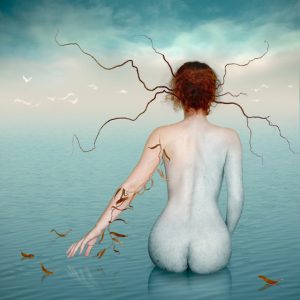
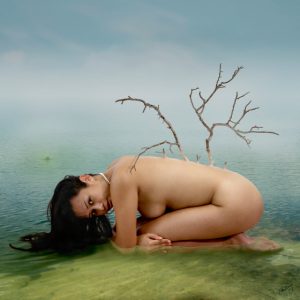
Your recent work such as ʺA Quest for Beautyʺ and ʺInfertilityʺ had in a way created social awareness about the problems we are facing today, would you continue with this kind of style?
Yes, I am planning to, in fact my two most recent works, Exodus of the Birds and Exodus of the Leaves are a look into the future and what it could become and probably will if humankind doesn’t change its destructive actions against the natural world. Infertility was planned to be part of a series called Modern Plagues, where I am planning to portray more of our (mostly social) diseases.
You have used apple, not once but many times in your images, does this forbidden fruit carry a significant meaning to you?
Many people have noticed this reoccurrence of the apple element, the truth is that it’s meaning should be judged in the context of each picture. The apple is loaded
with symbolism that starts in the Garden of Eden and goes all the way in Newton’s observation of the laws of physics and beyond that.
What are your most representative images and why?
I would list here The Suicide, In My Other Life, Sunset Over the Ocean, and A Quest for Beauty. The all have strong and complex concepts behind them, which is something that I always aim for, are fairly original as expression and quite complex as technique.
In your view, what constitutes a good photo?
To me, a good photo is less about the mastery of the technique as it is about the idea behind it. A good photo needs to make you think or to make you feel or both for them. Or it needs to surprise you by its originality, by throwing a whole new light on common things, by doing things differently than others before, by the exploration of new limits . When this is paired with great technical skills, it reaches
perfection. We live in a world where everyone is a photographer. Everything around us is paved with images of stereotype beauty. A good photograph needs to express something of the photographer’s personality, beliefs, emotions, or inner world. A piece of his or her uniqueness.
Whatʹs your advice to aspiring young photographers?
It’s hard for me to give advice as I consider myself to be a young aspiring photographer. But I will dare to say – study, read, practice, seek for advice when needed, and, of course, think before you press the button.
What camera equipment are you using now?
I am using a Canon XTi with two lenses: Canon EF 90-300 1:4.5-5.6 and Canon EF 28-90mm 1:4-5.6 III.
What are you currently working on and what are your projects in the near future?
As of late I have been busy with my book, but I am also planning a new series which I am very excited about. I might add another Exodus piece to the duo already in my gallery, and I am also looking forward to continuing the Modern Plague series and to working on several other ideas that have been impatiently waiting in my sketchbook.
Madalina Iordache
Born in Romania in 1982, she grew up painting and drawing, and then studied Journalism in university.
She lives and works in Fort Lauderdale, Florida as a graphic designer for Ardis Creative and a gallery artist represented by James Schot Gallery.
Her images start and end as photographs, with each image composed of many photographs, combined to create a picture that is a frame in a story, a snapshot of an image lit by imagination, by memory, by thought.
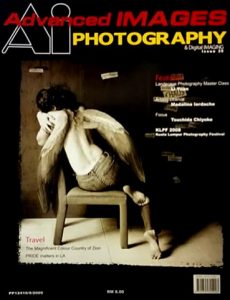
This article was published in Advanced Images Issue 39.