When I first saw your images, I was totally blown away, I am sure many felt the same. Was that your motive for the series? To create the “Wow” factor?
I’m not sure I have ever tried specifically for a “wow” factor, I was just trying to replicate something I had seen before. It really did start up as more of a technical experiment. I wanted to see how finely I can divide events temporally. Turns out, with the right flashes, you can freeze motion at a pretty high speed. The first time I did this, I had one glass full of water. I dropped the glass and mashed the shutter and I managed to capture the image on my first try. From that I started to punch things up and design more elaborate methods and bigger breaks. From what you see, there’s not much more there. I feel these images portray a feeling of their own, but due to the nature of the type of image, it’s difficult to set up a particular emotional state ahead of time.

I am sure our readers would like to know earnestly how did you create those shots. Can you share with our readers, “the making of” the series? Like how did you break the glasses? Did you drop them or shot them with pellet or something similar?
The set-up for these shots is really pretty simple. I get some cheap glasses, either from the thrift store or from Target and fill them with colored water. Then I either drop them, drop something in them, or shoot them with a bb gun. My background is a masonite countertop and I used plexiglass for the surface for easy clean-up. These shots will often result in bits of wet glass stuck all over the walls and ceiling resulting in the occasional atrocious clean-up.
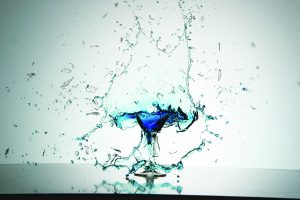
What kind of equipment did you use to create the series? Including the camera, lenses, lighting setups and other apparatus.
My current set up is pretty simple. I have a Canon 30D usually mated to a Tamron 28-75mm f/2.8 lens for these shots. My lighting is a few Vivitar 283 flashes with manual adjustment. I also have an inexpensive sound trigger I got online. Over the years I’ve used various combinations of Canon cameras and lenses.
This is my current process: I set up my gag. I will then set the camera shutter speed to 1-2 seconds in a completely darkened room. The microphone for my sound trigger will be somewhere right out of frame and wired into a flash (or 2). The flash is set at its lowest power, which gives you the shortest burst of light, somewhere on the order of 1/30,000 second. The light is usually set to backlight the glasses, as glass loves to be backlit. I make sure the light falls off on the sides so there’s a bit of darkness to the edge of the glasses. Then I hit the shutter and drop the glass. The glass hitting the plexiglass makes a noise which gets picked up by the sound trigger which then causes the flash to fire. Then I check the image on the LCD on the camera. If I’m happy with it, I move on. If I need to re-do it, I clean up and start over.

What did inspire you to create the series?
It was pretty simple really. I saw a shots online of Doctor Edgerton, the one where the bullet is passing through an apple, and I thought it was absolutely insane that moment could be captured. That something that there was no way that it could be seen. There’s so much going on in such a small slice of time, there’s so much going on in these spots that will never be seen. I thought that was absolutely fascinating.
Any advice for photographers who would like to experiment with such ideas?
A few things. First off, is that breaking glasses result in a huge mess. There’s a patina of broken bits of wet glass all over everything and it’s horrible to clean up. A shop-vac is really pretty helpful for this. Glass, if you do decide to go that route, really likes to be back-lit. You see a lot of flat images of glasses breaking online that are front-lit and they wind up really looking flat. Don’t be afraid to experiment. If you do exactly what everyone else is doing, your images won’t be unique or fresh. Also, if you can use already damaged glass, do it. You can’t tell the difference and you’re not wasting a new glass.

I remember you did tell me that it is better to rely on one’s reflexes rather than on the equipment, can you explain why?
I’ve kind of moved away from that, but I still stand by it. I really liked doing that by reflexes, because it felt more immediate and involved. I felt part of the image, and I felt part of the process. That being said, I’ve moved away from doing that kind of shot because the lack of repeatability. With a sound trigger, I can set up a shot and do it over and over until I nail it, changing the timing slightly between shots if needed. That being said, there’s definitely something mechanical and depersonalizing about that method.
What’s the most challenging aspect in creating those shots?
Making things fresh and different. After I’ve created a shot, it’s done and it’s time to move on to the next. At some point you need to mix it up and do something different. That being said there’s so much you can do with this, and if you need to walk away from it and come back, then you can.

How long does it take from setting up to the finishing of a particular shot, take the “Plink” for instance?
Obviously, it depends, but for a shot like “Plink” it took a while. That day I was fiddling around with timing. I like to get breakage that wasn’t too violent, so there are larger drops and frozen motion as opposed to a fine mist. This shot since I was testing things out wasn’t a long set-up time. I put a glass down with my standard light and shot the glass with a BB gun. I did this one several times until I got the shot I liked. This shot has very little photoshop other than contrast adjustment and sharpening and s slight crop.
Were some of the shots created in a single session or did you just produce one single shot in a session?
It depends. Sometimes I can spend hours on a single set-up and shoot. Other times I plow through a bunch at once. It depends on the luck of the draw, and my inspiration and motivation levels at the time. The two shots “Green”, and “Blue” were shot within minutes of each other, whereas “Broken Primaries” and “Primaries 2” were months apart.
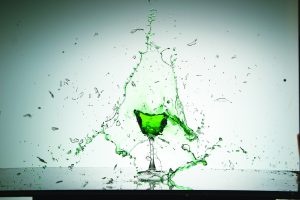
The shot “Green” was obviously shot using very high speed, just how fast was the speed?
“Green” was shot with a rather long shutter speed. It was shot with a 1 second shutter speed, f/5.6 ISO 100. I shot the glass with the BB gun again and used a low-powered flash to grab it. The single light at low power lets all the little bits be captured without ghosting or blurring.
Obviously there were lots of energy released in the split second what kind of enlightenment do you get from being able to see the moment?
These are events you can’t see, even though they happen right in front of your face. When you are out shooting, sometimes you nail a shot, and you know you’ve nailed it. With these shots, I don’t know what has happened until I check the LCD. The instant that I capture is such an infinitesimal stretch of time that didn’t occur milliseconds before or after. This is universally true for all photography, but I feel that these type of shot in particular compress time into such a singular point, the act of capture is the creation itself.
Of all the shots you have created in the series, which was the one that left most “impact” on you?
Probably Broken Primaries. This was a shot that I did early on that made me realize that I could capture the motion and create an aesthetically interesting image at the same time. That it wasn’t just a technical exercise, but that I was actually doing something that was interesting to look at, and that had meaning for people. That was the first image that I ever made that actually excited me.

Where do you plan to go from here?
I plan on trying to put these shots into a context. To create a scene where these things are happening outside of just the breaking and shattering.

As with most photographers now, his work is entirely digital.
Steve lives in Washington, DC with his muse & wife and two squishy pugs.
This article was published in Advanced Images Issue 42.