When taking pictures outdoors, the most important element aside from the subject matter is timing. In landscape photography, that timing is translated to mean light but also season. Among the seasons, I prefer to take pictures in autumn and winter. In a temperate zone, autumn is the season when foliage turns the field into a wide spectrum of colors. The attractiveness of winter, however, is harder to explain aside from the fact that landscape covered with snow is a novelty, particularly to those who live in tropical countries.


Unlike images of human interest, an image of landscape does not offer a story or something viewers can relate to immediately. An appealing graphic design is needed to draw the viewers’ attention. It is often said that while a photographer wants to capture an expressive pose of his/her human subject, he/she would look for ideal composition in an image of landscape. Unfortunately, for a photographer in the field, he/she can only search and find what is out there but he/she is not in a position to impose his/her own design. Snow helps to establish a visually more elegant and simplified scenery. In other occasions, snow adds an element of the unexpected.
Jilin City in China is known for frost on trees in winter. Located at a bend of Songhua River, Jilin City is surrounded by water on three sides. Because of a power generating station upstream, this stretch of Songhua River does not get frozen even in winter when the air temperature plummets to 20˚ below zero. When weather conditions are ideal, the moisture from the river rises. As soon as it gets in touch with the icy cold tree branches on the shore, it turns into frost and clings to the branches. The setting is like a winter wonderland and attracts visitors all over.
To practice winter photography, two issues have often been raised; viz. how to prepare oneself to be out in cold weather conditions and how to expose the picture when everything seems so bright.

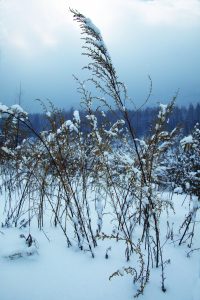
Old wisdom often calls for over-exposure when taking pictures in the snow. The logic has to do with the design of exposure meters. Practically all exposure meters give out a reading known as “18% grey”. It simply means that whatever the subject matter (or incoming light) you are metering at, whether it is pure white as snow or a dark surface, the reading will tell you how to expose so that it will come out “18% grey”. In colloquial terms, it simply means off white. Therefore, if you want pure white snow, you have to overexpose it. However, as the exposure meter in cameras get more sophisticated with multiple sampling, the reading gets to be some kind of average of the white and dark areas within a view finder, making the white area lighter than the standard “18% grey” and the dark area darker. Taking that into consideration, I find that I can get proper exposure most of the time without any manual correction unless the image in my viewer is all in white (or black). For those who are uncertain about taking pictures in the snow, I would suggest bracketing the exposure by taking one picture according to the meter reading and another one at ⅓-½ stop of overexposure.


Frost gathers on an old tree on Wusong Island. The picture was shot in dep-mode with evaluative metering with EOS-1DS camera and EF16-35f2.8L lens.
To be out in the cold can be taxing for those who are not used to such weather conditions. My own experience tells me that not only should I dress warm but also make sure that I have something to eat before venturing out so that I have energy in reserve. Your hands should be protected but not to hamper the operation of a camera. If you should use a tripod, it must be insulated so that the metal will not touch your bare skin. Furthermore, avoid staying outside for more than a couple of hours. However, if you should return to a warmer environment, be it a room or inside a car, make sure the camera and lens are covered so that they will not get fogged due to condensation.
Winter photography can be fun if you are prepared.
This article was published in Advanced Images Issue 41.