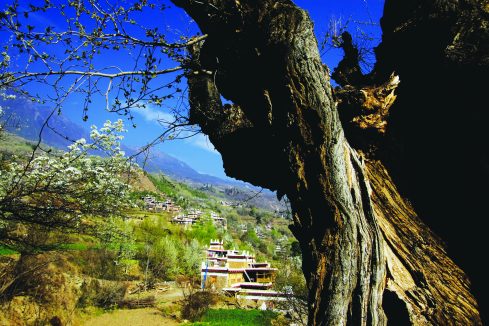

CANON EOS-1V
EF 16-35 f/2.8 L lens
DEP setting, 12% partial metering
As you stand in an outdoor environment, the land is wide open. The view is broad and even magnificent. The landscape might prompt you to raise your camera and there is a temptation for you to snap the picture. What do you wish to capture?
When the camera was invented and photography was first introduced to Japan, Japanese used an existing expression “写真” (“capture something real” in translation) to described this new process. However, in landscape photography, what the camera captures is not merely a record; it can express your feelings about the view and perhaps something beyond. The great poet, Li Bai, of Tang Dynasty once wrote, “The flock of birds has flown away. The cloud hangs alone in the sky. The only thing in view that I am not tired to be accompanied with is the Jinting Peak”. In describing a transitional moment and by contrasting the lone cloud with a flock of birds which kept in company even in flight, he poured out his feeling of loneness.
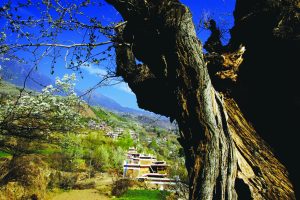
CANON EOS-1V
EF 16-35 f/2.8 L lens
DEP setting, 12% partial metering
Although the wooden structure in the distance is the resident building of Tibetan nuns, there is nothing in the picture to suggest the relationship between this building and the prayer flags in the foreground. However, by placing them within the same frame, I left the thought to the viewers as to the connection between the two elements. CANON EOS-1V EF 16-35 f/2.8 L lens DEP setting, 12% partial metering
When I first learned photography, my teacher, Helen Menzer, often told us, “Before you release the shutter, ask yourself what captures your attention. Then try to put an emphasis on the part that does so in your picture”. Unlike a picture of human interest, a picture of landscape does not have a story to tell and the connection between the photographer and the viewer in this genre is far more subtle. Partly for this reason, an appropriate title is often considered important if you should decide to enter such a picture for competition. However, I often feel that a picture, if properly framed, should be able to tell the viewers how you feel about the scene without relying on words. Furthermore, not only do I often find it as a challenge to convey my feelings through a picture without the help of words, I think titles and words actually restrict the way viewers might otherwise contemplate. The important part of a landscape picture is to make the viewer feel as if he/she can enter the setting, and thus relate to it. To make it possible, something identifiable and common, such as a tree or an opening in the foreground can be helpful.
On the other hand, we must differentiate between what we see and what we capture in a picture. In the field, while our eyes can see everything in sight, we can focus our attention on one particular aspect. However, the camera (and the picture captured) would pay equal attention to everything within the frame. The selective process must be done by the photographer before he/she snaps the picture. In doing so, a process of elimination is performed and the picture is no longer the image of reality. It becomes a creation by the photographer. As such, a picture is but a single facet of the reality. Thus John Szarkowski stated in his article, “The Photographer’s Eye”, “once outside the studio, the photographer could only record what he found. Intuitively, he sought and found significant detail. His work, incapable of narrative, turns toward symbol.” Therefore, we must emphasis on what we would like others to see.
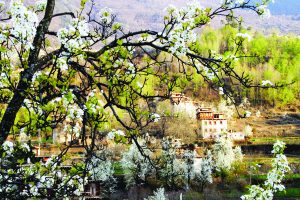
There are many ways to make the emphasis. The process of bringing out the relevant details of a scene can be accomplished, as I mentioned in the previous article, with the help of “time”, “the frame”, and “the vantage point” in picture-taking. Here, we shall concentrate on a useful technique in bringing out the emphasis by borrowing from what Li Bai did in his poem. To juxtapose two seemingly unrelated elements with the frame not only would enhance the composition by addition to the main emphasis with “supporting cast” but also entice the viewers to add their own interpretations to the picture.
It is often said, “a picture can tell a story better than a thousand words”. If we should give more thoughts to the question,” What do you wish to express?”, we can bring out more meaning to a landscape picture
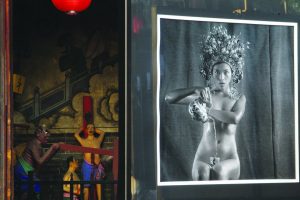
CANON EOS-20D
EFs 10-22 f/3.5-4.5 lens
A-Dep setting, 12% partial metering
CANON EOS-20D
EF28-135 f/3.5-5.6 IS lens
A-Dep setting, 12% partial metering
.
This article was published in Advanced Images Issue 40.