Like any other form of photography,
you need to be passionate about the
subject you are photographing. That
passion for the outdoors really does help,
as it relaxes, motivates and inspires you
when on location.
As a landscape photographer, what do you like to convey through your art?
I simply love the places that my photography takes me to, and the special moments in which I see these places. All I hope to achieve is to share with people a little of the natural world as I see it. I would be overjoyed if I knew my pictures helped to widen peoples appreciation of the natural world, because from a conservation point of view that can only be a good thing.
What do you think is the prerequisite of becoming a good landscape photographer?
Like with any other form of photography, you need to be passionate about the subject you are photographing. That passion for the outdoors really does help, as it relaxes, motivates and inspires you when on location. You also need to be both patient and determined as the most important factor in you capturing a special image is the quality of light. The weather is completely unpredictable (especially in the UK!), so you often come home with no images at all, only to return to the same location again and again in the hope of a brief glimpse of magic. On top of everything else, you need to be pretty good at getting up early in the mornings!!
How important are photographic gear compared to artistic vision in landscape photography?
People tend to get too weighed down by the technical side of photography, but for me the creative, inspirational side is far more important. Its easy for me to say that when I’m using the latest and best Canon SLR but really all my images could have been just as easily captured using the cheapest DSLR.
As far as I’m concerned the equipment lies in fourth place behind the quality of light, effective composition and subject matter. You can take a brilliant shot with the cheapest camera if you have good composition and light. But you will struggle no end to photograph well with the most expensive camera if you have no light and a bad composition.
What equipment do you use at the moment? (Including computer.)
I use a Canon 1DS Mk3 and EOS 5D, EF17-40L, EF24-70L and 100-400L lenses. I have a ‘struggling’ 3ghz PC with not as much RAM as I would wish for, and a small army of external hard drives which keep filling up!!
You have obviously been traveling to various places on the planet, how did you discover the scenes in your photos? Do you plan to the particular spots or was it by chance you discovered them?
I research using the internet before I go on trips to give me ideas on potential locations. But really its just a case of going there and making the best of it. I try to be on location at the right times (dawn or dusk) and then shoot what I find. In an ideal world it would be good to visit all these places in daylight to find subjects to return to later at sunset, but as these are holidays as well as photo trips I cannot afford to hang around in one place that long.
Of the many places you have traveled so far, where were your favorite locations?
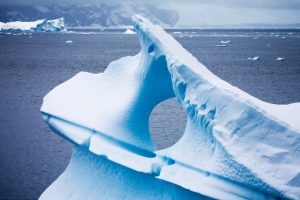
My favorite country by far is New Zealand. Its such a special place with very friendly people, a beautiful diverse landscape and a sense of wilderness. For sheer jaw dropping beauty I have never (and surely will never) visit anywhere like the Antarctic Peninsula. It is a humbling experience to cruise through its white wilderness. If I could close my eyes and transport myself to anywhere on Earth, it would be to here.
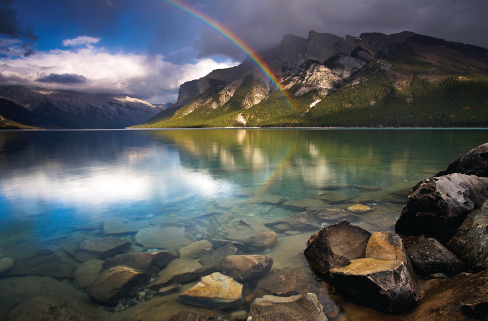
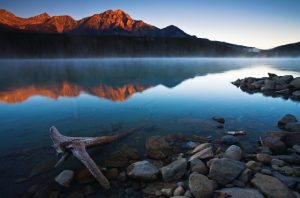
Your “Lake Minnewanka, Banff National Park, Canada” series were just breathtaking, how long did you take to create those shots? How many trips were involved?
Just the one trip. They were taken on my honeymoon in the Canadian Rockies. It was mid-afternoon as we were driving back towards our hotel when I noticed some light on the mountain on the far side of the lake. Normally I wouldn’t even consider taking photographs at this time of the day, but I decided to give it a try. As soon as I had set my tripod into place and camera on top, it began to rain. I cursed my bad luck, packed up and ran back to the car to take cover. I thought about driving off, but instead decided to persevere.
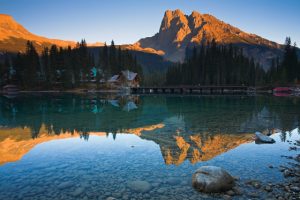
After the rain stopped, I returned to the lakes edge and set the camera up again. Once again, it began to rain as soon as I was ready to shoot. Rather than pack up, I decided this time to throw a cover over the camera and wait in position. I was so glad that I did so, because as soon as the rain stopped this beautiful rainbow appeared directly in front of me, right in the middle of my chosen composition. I excitedly took a couple of shots, one vertical and one landscape and then the rainbow was gone again.
Can you share with our readers, what are the process involved when you want to photograph a scene, such as the application of filters, composition, lenses, metering and etc.
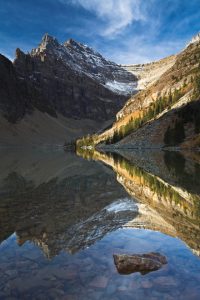
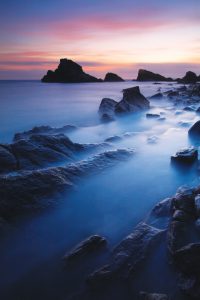
I use Neutral Density graduated filters for virtually every landscape shot. This helps to balance out the exposure between the bright sky and much darker foreground. In addition I often use a polarizing filter to cut down on bright reflections and therefore boost saturation in images. I favour wide angle shots with big foregrounds, so I’m usually using my 17-40L and setting the tripod low to maximize foreground objects. Compositionally I try to keep the shot as simple as I can, with the foreground object leading the viewer into the main part of the image. I’m lucky in that composition comes very naturally to me, so I don’t need to pay much attention to the order of things.
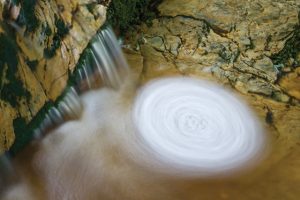
We find your image “Spinning Circles” particularly interesting, can you tell us something about the image “Spinning Circles” from the Nature Pattern series?
I was photographing in Exmoor National Park when I noticed this small circle of foamed water. There were actually two circles, but I decided to focus on just the one. As the foam was trapped by the current of the small stream it was spinning around. I set up the camera and chose the lowest shutter speed I could (I think it was around 6 seconds) to capture the motion of the spinning.
Its not the sort of photograph that I usually take, but I was very pleased to have spotted and captured it.
 What is your view on the over development in certain parts of the world? Apparently many forest and natural habitat had been destroyed ruthlessly. What do you think should be done about such acts?
Its always a delicate issue because many of the countries who are destroying forests are poorer nations and this provides a vital source of income. However, the wider issue is that the natural habitats which are being completely devastated will never be able to recover in the same form. We as a species have to learn to come together somehow to act as guardians over the planet because its going downhill at an alarming rate.
We understand that you will have a new and first book publish soon, can you share with our readers something about the book?
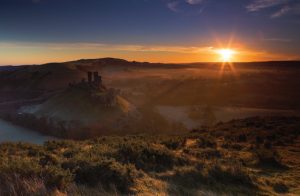
The book is a coffee-table style picture book (along with captions) of the Dorset Coast in England. It is a fascinating stretch of coastline which for a large part forms the Jurassic Coast World Heritage Site. The coast is famous for being a fossil finding hotspot, as well as being incredibly diverse geologically.
The book helps to show a wilder more remote side of England that many people from overseas don’t realize exists. Far away from the London’s red buses and telephone boxes the Dorset coast consists of a spectacular and in some places wild stretch of coastline.
Signed copies will be available to buy direct from my website when it is release in October of this year.
What was your most memorable experience doing landscape photography?
That’s a difficult one to answer. I’ve been fortunate to witness many beautiful locations at very special moments. Certainly one of the most special was photographing Milford Sound in New Zealand last year. I had visited Milford Sound on two previous trips to New Zealand, both before I considered myself a photographer. I took shots using my compact camera which would inspire me to start taking photography seriously many years later. So a return trip to New Zealand, and Milford Sound was always going to be special. Once on location, everything fell into place, beautiful dawn skies, a placid fiord and wisps of low clouds at the base of the mountains. To top it off, there were no tourists around to spoil the atmosphere.
You have traveled to Antarctica, what was your first impression when you got there?
It is an utterly incredible place, and I felt humbled to be there. It’s a very strange feeling, almost dreamlike to be standing on the deck of a ship looking towards complete wilderness, knowing with confidence that there is absolutely nobody looking back at you. Antarctica is a very space place, a memory that I will always treasure.
What were the most challenging aspects when shooting in Antarctica?
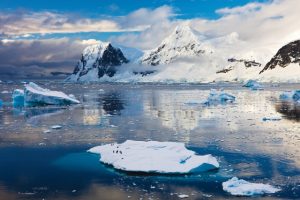
Photographically, for a landscaper, Antarctica is a complete nightmare!! For much of the time you are either photographing from the ship, or a small boat so a tripod is out of the question. Also, as the ship or boat is usually moving, you have to react quickly before the subject drifts away. Compositionally speaking, you have no choice but to make the most of the situation offered you from the boats position.
Once on land things are only slightly easier. As you would expect pretty much everywhere is covered in snow. Being a wide angle photographer I was often looking for an exposed rock for foreground interest, but in all the places we stopped any exposed rock was occupied by nesting penguins and I didn’t want to alarm them by coming too close.
As you are traveling with a group of people, you cannot wait around in a location, waiting for the light. After a few hours on shore, everybody heads back to the ship, and you dare not wait behind!! So you have to make compromises to your usual shooting process to fit in with the group.
On top of all that, the Antarctic Peninsula experiences storms every other day which can make photography very difficult. It is also renowned for its beautiful light, but we only had one brief 10 minutes glimpse of that in 10 days.
So it was a big challenge, but I wouldn’t have changed it for the world.
What are you working on currently? What’s your plan for the near future?
I am currently working on a new book project, photographing the Exmoor National Park in Southwest England. I am also planning several landscape photography workshops for 2009 in the Southwest of England, under the title of Visions of Britain (www.visionsofbritain.co.uk).
Any plans of coming to Asia, to countries such as Malaysia, Thailand, Philippines or Indonesia?
One thing that’ becomes apparent when looking through my portfolio is that I only photograph in colder temperate climates. This is because I do not cope well in the heat. So for that reason I have always chosen to avoid Asia, Africa and Australia as destinations. Maybe one day I will have reason to photograph in the tropics, but for now the chillier places like Norway, Canada and Antarctica are my preferred locations.
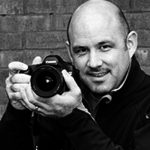
Adam Burton’s Biodata
Growing up on the south coast of England, with the New Forest on his doorstep, Adam Burton’s photographic interest began with a passion for his unique natural surroundings. This love of the natural world enabled Adam to develop a photographic style which was dedicated to capturing the essence of wild and rural landscapes.
His photographs are instantly recognizable with their rich, vibrant yet natural colours and captivating compositions, each conveying the delicate beauty of the environment in which they are taken. While temperate landscapes and moody seascapes are undoubtedly his favourite subjects, he also enjoys the more intimate close up subjects, which provide a challenging change to his familiar style.
His favourite time to photograph is at dawn when the light is magical and the landscape quiet. ‘This is the time when I feel most alive. To be in a remote, beautiful location with nothing but the wildlife as companions is so invigorating for me – a world apart from the hustle and bustle of daily life. To witness the beauty of these moments, and to have the opportunity to capture a little of it continually inspires me’.
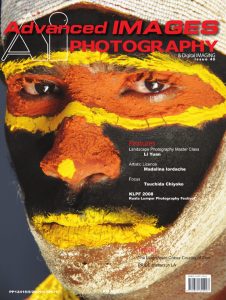
This article was published in Advanced Images Issue 40.