Photographer: Manu Mart (Spain)
Interview by: Jessica Chan
Manu Mart
He is a freelance photographer based in Barcelona, Spain. He has often travelled to Asia like India and most of the Southeast Asian countries doing projects helping NGOs in their worthy cause. His photographs have been published in Leica M Magazine, Leica Fotografie International blog, El País or Vice Magazine, and exhibited in different galleries in Madrid, Barcelona, Londres and México. He is also an active member of Calle 35, a photography collective based in Spain.
 Manu’s work mainly is focused on street photography as it is the base of photography to him. There are many things that happen on the streets especially daily life or work. The street is very important to him and he believes working on the streets can improve a photographer’s skills when trying to document life and different situations.
Among Manu’s projects are local work from his home country Spain like “BCN Sea View” in Barcelona, that reflects life during summer time in the main beach in his hometown, Barcelona, and “Alcala 237” in Madrid. “Alcala 237” is all about shooting the mood around the bullfighting arena where there are many types of very special people who go to the bullfights. Another one of his projects “Walkin’ Madrid” is especially important to him as Madrid is the place where he was born and he left after his father passed away. It wasn’t until he received a scholarship to study photography in Madrid that he decided to go back. Many of the images in “Walkin’ Madrid” are dark and shadowy expressing the sad memories he had of this place.

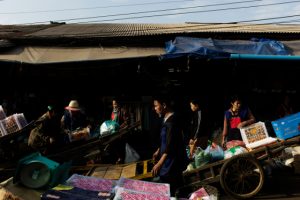
Manu’s other works are based in Asia and his final aim is to make a long term project about the importance of street culture in this continent. He found that streets in Asia are very different from those in Europe. For example, people can have their hair cut on the streets, clean themselves or playing; many things happen on the streets which he found very interesting. In Europe, streets are becoming more and more a private space, and every time it is more challenging to shoot strangers on the streets as they feel you are invading his privacy. Streets in Asia are more open. He travels for a few months in different parts of Asia every year and this is also why he is in Malaysia now. These are his personal projects. Most of them were made without assignments because he simply loves to do it while some of them are commissioned projects. His projects in Asia include “Young Warriors” which is about the life of children in a charcoal factory in the slums of Manila; “Rainbow Pain” about the effects of chemical substance during the Vietnam War; and “MSF Camboya TB” was project for Doctors without Borders.

As a photographer he does not limit himself to just being a street photographer, he shoots what he wants and what he feels that he wants to shoot. He doesn’t set boundaries upon himself. “One may specialize in a certain type of photography but if you stick to just that type of photography, you are limiting yourself to find a new story that deserves to be shared with the world” Manu said. A photographer should not limit himself to just a single type of photography. To him, all photographers must practice street photography regardless whether they are fashion or wedding or any photographer. This will train them on fast composition and managing light properly, which will eventually help them in their photography work.
 The project “Young Warriors” is one project that touches him most. The plight of these Filipino children was published in an important media in Spain. A few months after, the neighbourhood was expelled by the local government. He felt confused whether it was the international media attention that has forced the children out of their habitat. These children do not have families but they lived together as close friends. Now they have become street children. One of the intentions of photography is to help people and this made him unsure of whether it is helping them or not. This is a little sad for him but he has done his best. Generally, he is happy with his work as every project is special to him.
 For the past 5 to 6 years, Manu has travelled to various parts of Asia every year. He has been to India, and most countries of Southeast Asia like Philippines, Cambodia, Vietnam, Laos, and now he is in Malaysia. He is working on a mission from the Embassy of Spain. As it will be the 50th anniversary of diplomatic relations between Spain and Malaysia, the Spanish Embassy wants to promote Malaysia amongst the people in Spain and Europe. The Embassy decided to introduce a unique cultural exchange by inviting artists like photographer, music group and cinema director to Malaysia. He is here on a mission to discover how Malaysia is now in the 21st century and 60 years after independence; and also the daily life of Malaysians. These photographs will be presented in exhibition and published in a book in Spain and Malaysia next year 2017 as Malaysia celebrates 60 years of independence and 50 years of diplomatic relations with Spain. This is to create awareness of Malaysia in Spain and Europe. Manu will travel around Malaysia doing his project in two months – April and May 2016 concentrating on the west coast inland and along the Straits of Melaka. He finds that Malaysia is amazing with people of different races Malay, Chinese and Indian living together. This project is also supported by Leica Fotografie International.

Back in Spain, Manu forms a collective with 7 members called “Calle 35” with the purpose to share knowledge and photographs of street documentary photography. This involves constructive discussions among the fellow photographer members for self-development and improvement.
Depending on the situation or the project, he may or may not do a pre-shoot concept. In the case of his project in Malaysia, he has to do a lot of background studies about the country. This project makes reference to the book “The Harmony Silk Factory” written by renowned author Tash Aw which was based on the situation of Malaysia before independence and during the Japanese invasion. This project was titled “Who’s Johnny Lim?” referring to the main character in the book. In his opinion, sometimes for street photography it is not necessary to study too much into the anthropology, culture, people and history. It is difficult to study streets. You have to wander on the streets to find things, to meet people and to meet the culture. It is unlike specific projects like the “MSF Camboya TB” which he had to find out about tuberculosis and “Wat Tmore Kre” project where he studied a lot regarding Buddhism as it is not his religion. Before going to a new place or starting a new project, it is important for a photographer to know if he is focusing on a specific topic, then he has to know at least a little bit about the topic. It is also good to look up some of the photographers in the new place as they might share some useful information. It depends on what you want to express in your pictures. Try not to be obsessed with too much preparation. Sometimes just go and look around. For his work in Malaysia, he likes to wander on the streets, talk to people, drink tea/coffee with people and they invite him to their homes.

On the question of how to enjoy the process of street photography, Manu has this to say. He noticed some photographers love street photography but they are afraid to approach the subjects. If you take too far from the subject, the photo lacks the closeness with the subject and it looks like a spy work. He prefers to go closer, shoot and then, ask for permission. During his trip in Malaysia, he never had any problem when he gets closer to the subjects because he smiles before asking for permission. He advises street photographer not to force yourself to go out to the street, you have to really feel you want to go out and take your time. If you have to spend the whole day working, then do it and lose yourself in it. Go and discover new places to avoid getting bored. Never force yourself or tell yourself you have to shoot. If you are not in a good mood, don’t go out, just stay at home, train your eyes and look at some other photographers’ work. Manu carries his camera with him wherever he goes. His advice to street photographers: get used to your own cameras.
This article was published in Advanced Images Issue 80.