Photographer: Alexey Furman (Ukraine)
Interview by: Jessica Chan

1) What leads you to where you are today in photography?
 I come from a news background, but I have shot longer-term stories for magazines, as well as my own documentary projects. I was beaten, got arrested, and did a lot of crazy things while working as a photojournalist. A keyword for photojournalism, I think, is “involvement”. If you are detached and indifferent, it doesn’t matter if you photograph a news event or a year-long project, it will unlikely come together. At some point, I think after a year, I realized that it is not a job, but a style of life. And I continue living it and staying involved.
2) Why is documentary photography meaningful to you?
 Last fall I was doing a story about a rap singer once, nothing extreme, just a photo story I was doing for a class in Missouri School of Journalism. When I finished and brought him the printed pictures, he told me, “Thank you. Your pictures made me look at myself through a different perspective”. I believe we appear in people’s lives, as they appear in ours, for a reason (everything in life happens for a reason, right?). We have to remember to give, and give a lot, because we take a lot too. There were several instances when I shot the stories solely to help people or to help raise social awareness for the issue. I believe we have to think about people first. I always live by the rule that if I by taking a picture can even slightly insult my subject, I won’t take it. I don’t care if by the end of the day I have a picture of not, I always put the feelings of my subjects on the first place.
3) Your series “War in Ukraine” is very touching. Please tell us how you made it.
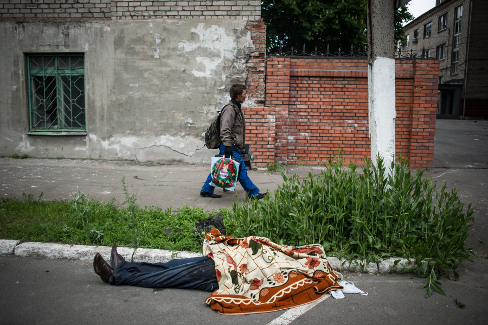
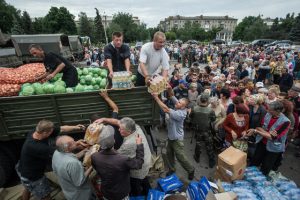
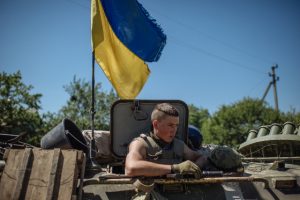 Euromaidan, the Ukrainian revolution, literally started in my backyard. As a photojournalist, I felt that the ongoing events had a historical meaning for my country, and I tried to devote as much time as I could to the coverage. I never thought of myself as a conflict photographer, and I didn’t have any experience, but I had to be there to capture the events and learn my way around in dangerous conditions. Peaceful protest turned violent in January 2014, and shortly after the first protesters were killed by the riot police. When the Ukrainian President fled, everyone’s attention shifted to Crimea where troops with no insignia started showing up, and I went there. That’s where my series starts.
 Annexation of the peninsula was hardly visual, but the month I spent there was unarguably one of the most crazy times in life. I watched a piece of land that belonged to Ukraine “drift away” without any interference from the international community, and it was extremely difficult emotionally. I took some time off, and in the beginning of May 2014, I went to Donetsk People’s Republic, where pro-Russian protests were slowly turning into a war that we witness today. For a Ukrainian photojournalist, it was extremely difficult access-wise. People were extremely welcoming to Russian journalists, but as they were blaming the new Ukrainian government in what was going on, they didn’t want to see anyone affiliated with Ukraine. In a couple of instances, I had to run away from the crowd that was ready tear me apart. After that I mainly cover the war from the Ukrainian side.
What I believe my series shows is how the tragedy evolved. Referendums where people expressed their opinions, “inspired” by Russia, turned into a bloodshed that eventually took lives of over 10,000 people. It is a tragic page of Ukrainian history, and I am afraid we are still on this page.
4) Your achievement in the Kuala Lumpur International Photo Awards – what is your opinion of it?
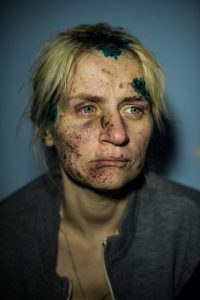
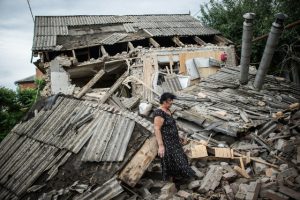 Both of my pictures that were featured in Kuala Lumpur depict tragedy. A woman from Odessa comes to a burnt Trade House building and cries, because someone she knew was killed there; a young woman from Mykolayivka sits in a dark corridor of a hospital, completely lost after losing her mother and everything she had to a mortar shelling. These portraits are stories of two human beings. Unfortunately, we have hundreds of such stories, and they have to be told in texts and photographs.
This interview was published in Advanced Images Issue 79.